Today on arxiv, I contributed to a paper describing plans for Target-of-Opportunity (ToO) observations with the Vera C. Rubin Observatory.
Rubin is a next-generation wide-field optical telescope that will begin operations in 2025. Though the original survey strategy for Rubin did not include ToO observations, the community has been advocating for a ToO program to enable rapid follow-up of transient events discovered by other facilities, such as gravitational wave detectors and neutrino observatories.
In this paper, we outline the scientific motivations for a Rubin ToO program, and specific trigger criteria with accompanying observation plans for the different scientific cases.
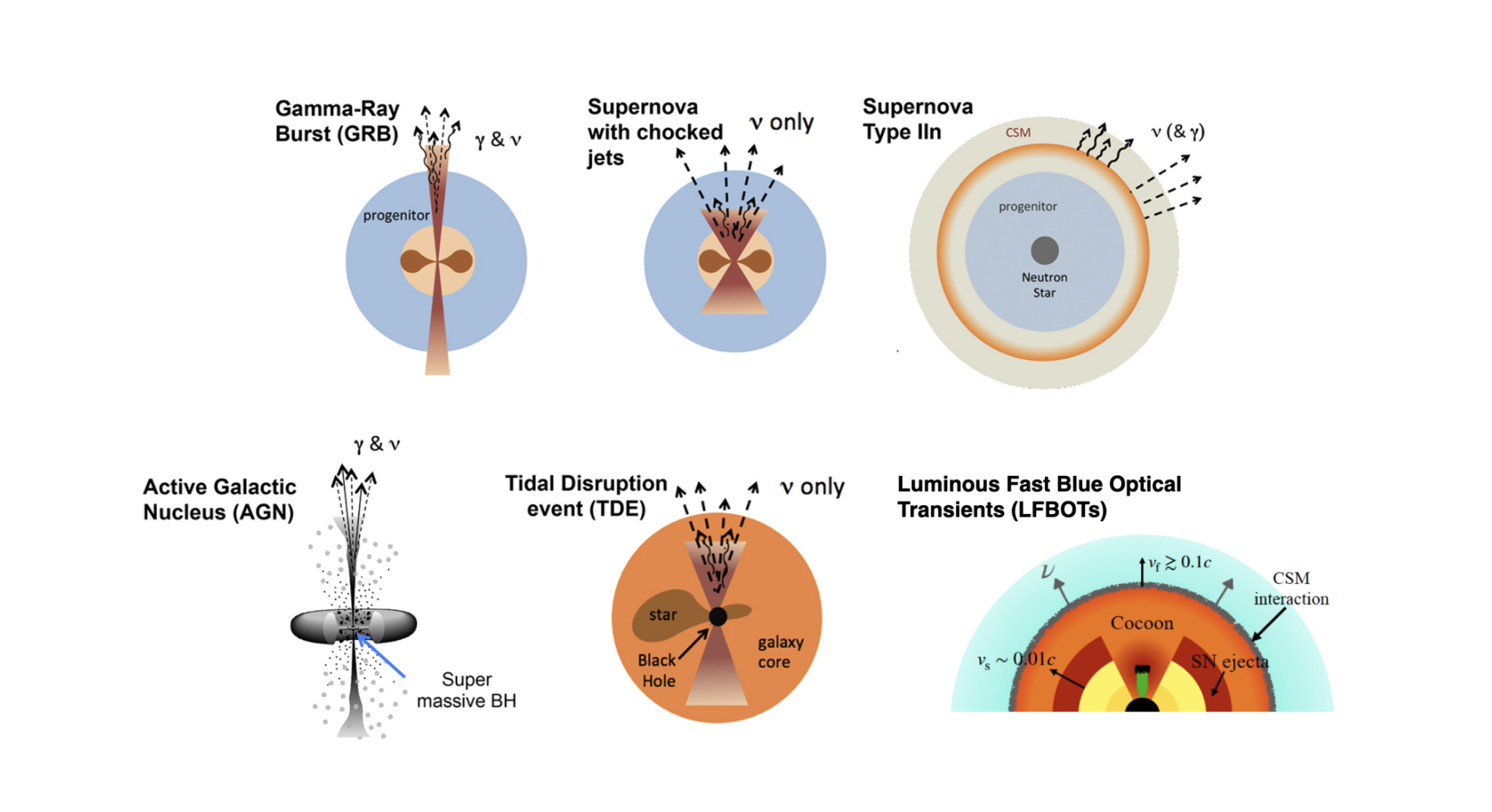
I led the section on high-energy neutrino follow-up, building on my experience with telescopes including ZTF, ASAS-SN and WINTER.
We are proposing a series of observations that would continue over two weeks following neutrino detection, in order to be sensitive to a wide range of different populations.
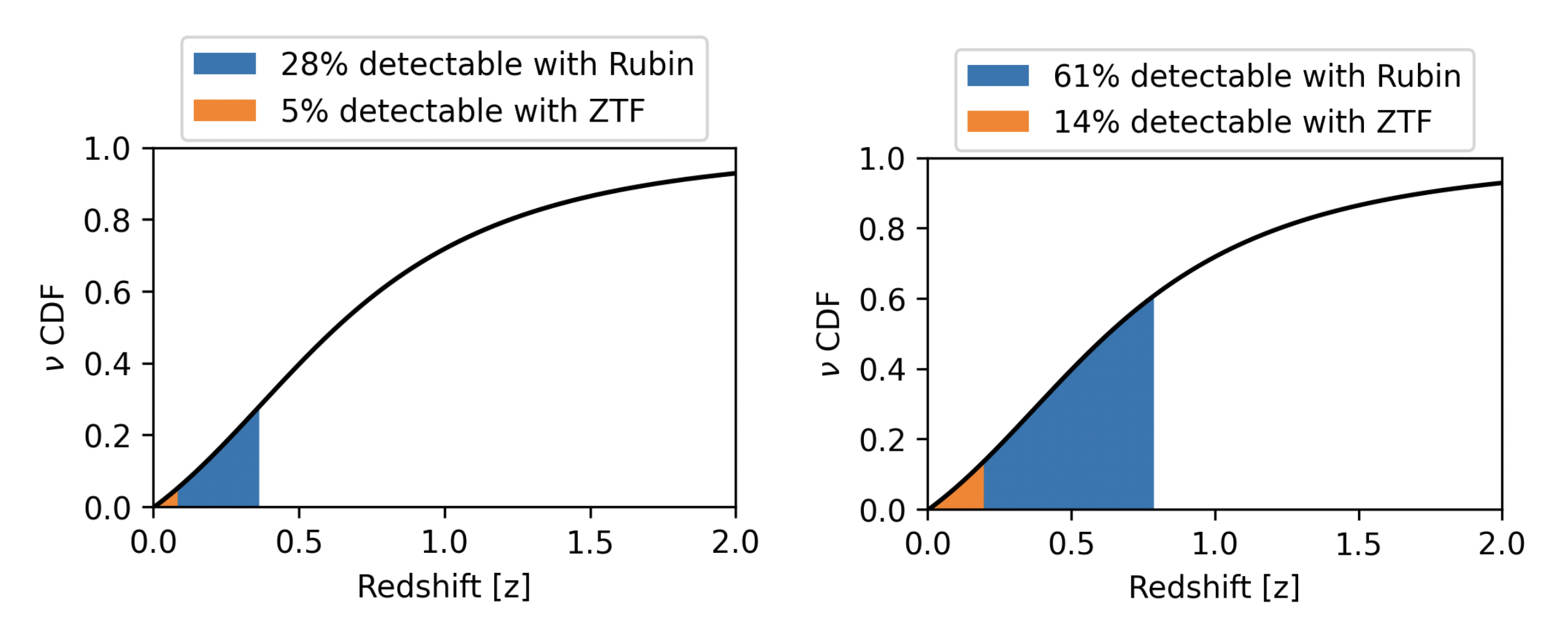
Relative to a facility like ZTF, Rubin’s excellent sensitivity will substantially increase the probability that a counterpart is discovered.
I also led the section on responding to the next galactic supernova, which will be preceded by a burst of low-energy neutrinos. If we are lucky we can expect just one such event in the lifetime of Rubin, so it is important to be prepared. A galactic supernova might be incredibly bright, but if it lies in the plane of the Milky Way it could be heavily obscured by dust, and thus only visible in the infrared. Our proposed Rubin ToO plan includes tiling in the i-band with varying exposure times to ensure sensitivity to both bright and dim counterparts.